
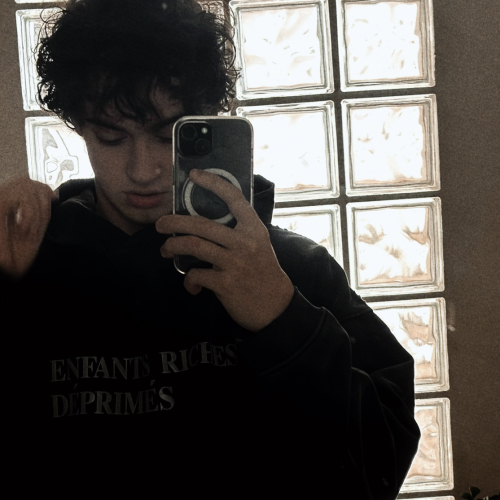

BACCO made his favorite beat ever on a day he skipped school. It started as a loop his friend Lulescu sent him, sat on his hard drive for months, and once he finally opened it, he finished the whole beat in about 20 minutes. He then passed it to Zazu, who worked on it with Hidemiyabi, and together they turned it into “Daikoku” on Eladio Carrión‘s CORSA. The album charted in the top 4 of Billboard’s Latin Albums chart, and “Daikoku” reached #37 as a single on Billboard’s Hot Latin Songs.
The Italian producer has studied classical music since he was about 10. He earned a Bachelor of Music in clarinet in March of this year and plays piano as his second instrument, but he only started producing four years ago, remaking Pi’erre Bourne and Ronny J type beats in GarageBand until his mom bought him FL Studio.
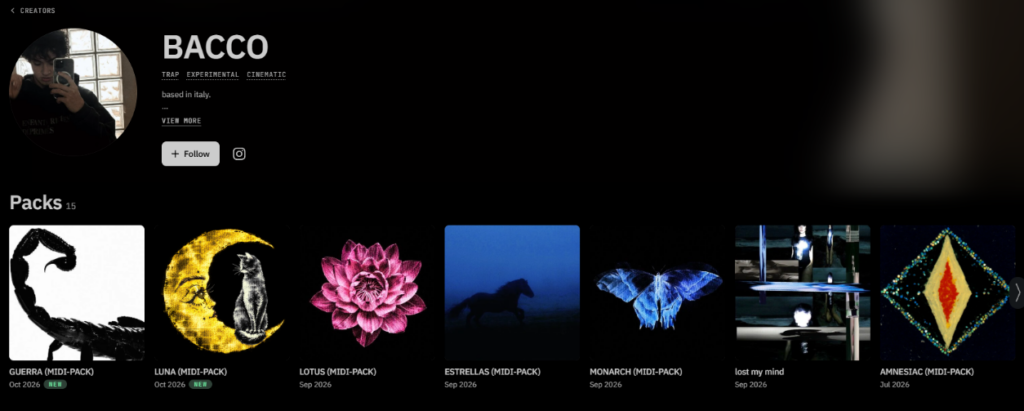
Since then he has landed a second Eladio Carrión record, “PURPLE RAIN” on ARCHIVOS ELADIO, and “CAN’T SAY NO” with Chris Grey, who found him through one of his viral beat videos. On WAVS, he has 15 packs and 489 samples, mostly synth-heavy, cinematic melodics and MIDI packs.
His beats travel far beyond WAVS too. The biggest one is a Kylie Jenner video set to one of his beats, sitting at almost 9 million views. His instrumentals have also been used by AS Roma, Inter Milan, Newcastle United, West Ham and Mercedes-AMG, athletes like Marcell Jacobs, Jimmy Butler and Djed Spence, and artists like JID, DaBaby and Russ. Those videos, and his producer tag being heard all over TikTok, are how he built most of the industry connections behind his records.
We talked to BACCO about the Daikoku story, how Chris Grey found him, his processing chain, and where he stands on AI in music.

MONARCH; ESTRELLAS; EFESTO; // Sample packs by BACCO
Q: For people discovering you for the first time, who’s BACCO? Where are you from, how long have you been making music, and what originally pulled you into production?
BACCO: I was born and raised in Italy in 2006. I’ve been involved with music since I was about 10 years old, studying classical music, which I still do to this day. However, I only started producing about 4 years ago, beginning with GarageBand, just making basic beats for fun and trying to remake Pi’erre Bourne and Ronny J type beats.
I got into production after a high school friend introduced me to US trap music, mainly Juice WRLD and Travis Scott, and I’ve never stopped listening to it since. I remember listening to those beats and thinking, “Damn, how do they make the actual instrumental?”
The major turning point for me was watching Genius’ Deconstructed videos, which are unfortunately discontinued, as you may know. Seeing everyone working in FL Studio made me decide that I wanted to do that too. I’m forever grateful to my mother for buying me FL Studio when I was just starting out. Without her, I wouldn’t be here writing this.
Q: Let’s talk about CAN’T SAY NO. Chris Grey is a huge name in music right now, sitting at over 8 million monthly Spotify listeners and behind LET THE WORLD BURN, which has 580+ million streams. Getting a record out with an artist at that level is surely a process in and of itself. How did the two of you connect in the first place, what’s the full story behind the song, and what was it actually like working with him and releasing CAN’T SAY NO? Can we expect more music from you two?
BACCO: Me and Chris actually connected through Instagram. He saw my viral video featuring the “GALE” beat and loved it instantly. His label sent me a full demo of the song. I listened to it and knew he was the exact artist needed to do justice to my beat.
I’m definitely working on making some more music for him, so look out for it.
Produced by BACCO
Q: You’ve also got two records with Eladio Carrión, “Daikoku” on CORSA and “PURPLE RAIN” on ARCHIVOS ELADIO. How did those come about, and what was it like getting that first one on a project of that size?
BACCO: Daikoku is to this day my favorite beat I’ve ever made. It started out as just a loop/starter that my boy Lulescu sent me in January 2025, which I decided to flip and add some synths over.
After having that loop sitting on my hard drive for months, I decided on a random day to skip school and make a beat. I remember that day vividly, working on that loop, which didn’t even have drums on it yet, and finishing the entire beat in about 20 minutes.
My brother Zazu was asking me for ideas and beats around that period, so I threw that beat into a pack for him. He later worked on it with Hidemiyabi, and they made the whole thing possible.
As for “PURPLE RAIN,” that was another idea Lulescu sent me. I made that beat at 5:00 AM while watching the World Cup, and then I sent it over to Hide. The first time I didn’t hear anything back, but I knew he must have just forgotten about it, because the beat was too hard to just sit on my hard drive doing nothing. So I resent it to him two months later, and they eventually recorded on it.
I wanna give a big shoutout to Eladio and Hide for really believing in my sound and the ideas I send them. Much love to ZAZU as well, who believed in my sound way before many other people did.
Co-produced by BACCO
Q: Outside of the music itself you’ve built a seriously big following on social media, and your reels pull numbers most producers never get anywhere near. What do you think you’re doing differently there? And for producers who want to build a real audience around their work instead of just making music alone in a room, what advice would you give them?
BACCO: Honestly, I just try to be myself and make sure that each one of my videos actually has a story to tell. I know it may sound like a cliché, but my main suggestion is to be yourself and keep posting no matter what. That’s what I was doing when I started. Now I’m focusing on bigger projects, so I tend to post whenever I genuinely feel like it.
Q: We have to get into the sauce now. You’re a master at that synth-heavy, practically cinematic sound. When you’re making a sample, what does your processing chain look like, and are there any VSTs or effects that keep showing up in most of your work?
BACCO: My chain is pretty straightforward: I just use the default clipper in FL Studio.
As for effects, I’m really heavy into distortion plugins like Nudistort (especially when you want to make a sound really stand out), and I’m also a lot into reverbs, especially all the Valhalla ones.
When it comes to mixing plugins, every single one of my beats has at least one instance of either Soothe 3 or Bloom 2 loaded. Oeksound was kind enough to send them to me, and I can’t live without them.

GUERRA by BACCO, his newest pack
Q: Let’s also talk about your beats and your own songs. How does your approach change when you’re building something complete rather than a sample for another producer to flip? Is there a technique or VST you swear by when you’re putting a whole record together?
BACCO: I usually just stare at my computer screen for a few seconds, trying to visualize what vibe I’m going for. Then I open a synthesizer of any kind and click through random presets until I find a cool one. After that, I slowly build the whole thing around it.
On the other hand, there have been times when I started with the drums first. Fun fact: that’s actually how the beat for “GALE” came out.
So there’s really no fixed rule. Just keep creating, even when you don’t feel like it at all.



AMNESIAC; LOTUS; LUNA; // MIDI packs by BACCO
Q: AI is impossible to escape lately, and it’s made its way into sample making as much as everything else. What’s your take on it overall, is it something you use in your own work at all, and where do you think it’s heading over the next few years?
BACCO: AI was definitely an unexpected phenomenon. When it comes to the emotional side of music and art, I personally approach it with a lot of intentionality. The whole point of art, in my view, is about translating real human feelings and raw emotions into sound, and right now, just typing a prompt that generates artificial music doesn’t really serve that artistic vision for me.
At the same time, I like to think about technology strictly as a tool to serve the creative process, not replace it. I think AI may actually have great potential on the technical and workflow side. In DAWs, mixing/mastering, or advanced audio-analyzing plugins, smart algorithms could take a lot of the heavy technical weight off our shoulders.
So it’s never about substituting the human element, but about using tools to optimize the workflow so that we can spend as much time as possible focusing entirely on the authentic human expression behind the music.
Q: What’s next for BACCO? What does the rest of this year look like, and how do you see the next three to five years shaping up? More records of your own, more packs, more placements, or something else entirely?
BACCO: Only God knows.
More from the WAVS blog: brody on building with the right people · Han on climbing to the top of WAVS · obac on finding his footing back into music
sample BACCO’s catalog here.